MarketArticle
Agentic commerce protocols explained — who is laying the rails, and what it means for sellers
Agentic commerce protocols in plain words. MCP, ACP, UCP, AP2 and the card networks, what is live, what is still a pilot and what sellers should watch.
On October 15, 2026, a shopping cart icon appeared on Google's homepage in the US, and it runs on agentic commerce protocols. It belongs to Universal Cart, where shoppers can save items from Nike, Sephora, Target, Walmart and many Shopify merchants, track prices and pay with Google Pay.
On the surface it is one icon. Underneath sit an open checkout protocol, a payment service, product data from many retailers, and an agreement that the merchant remains the seller of record.
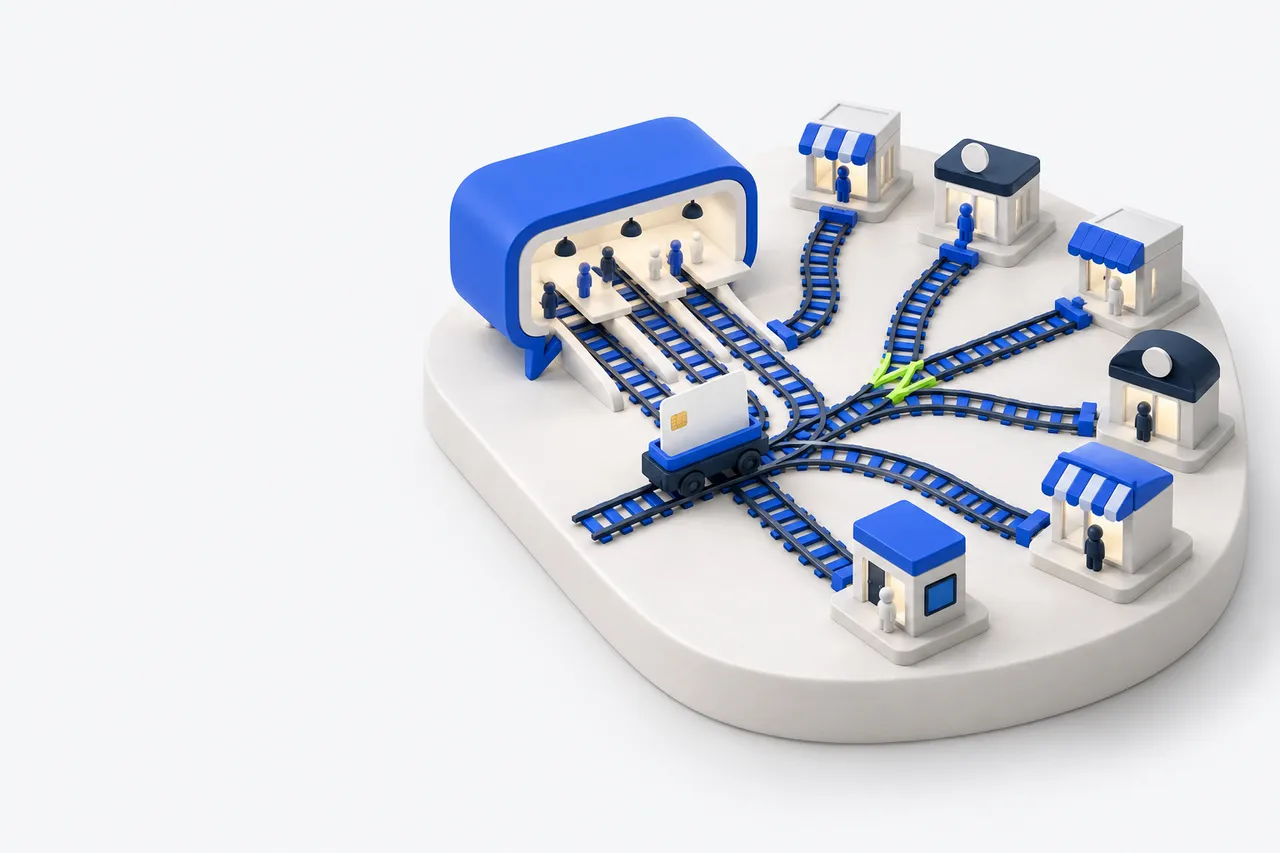
Those underlying agreements are what people mean by rails: shared rules that let an AI assistant, a merchant, a bank and a card network understand each other. Several large companies are building them at once, and each comes with its own acronym. Here is what sits behind them, layer by layer, from connecting an agent to a store all the way to payment.
Layer 1. The connector: MCP and A2A
To do anything inside another company's system, an assistant needs a standard way to plug into it. MCP (Model Context Protocol) is an open protocol that lets an AI application connect to external tools and data.
Anthropic created MCP and in December 2025 donated it to the Agentic AI Foundation, a fund under the Linux Foundation co-founded by Anthropic, OpenAI and Block. At that point Anthropic counted more than 10,000 public MCP servers, and ChatGPT, Gemini, Microsoft Copilot, Cursor and VS Code supported the protocol. The latest version of the spec was released on July 28, 2026.
A2A (Agent2Agent) handles a neighboring problem: how agents from different companies discover each other and coordinate work. Google donated it to the Linux Foundation in June 2025; the project launched with AWS, Cisco, Microsoft, Salesforce, SAP and ServiceNow.
Neither is a commerce protocol. They are the wiring that commerce protocols run on.
Layer 2. Catalog and cart: the ACP and UCP protocols
Two standards matter most here.
ACP (Agentic Commerce Protocol) was released by OpenAI and Stripe in September 2025, together with in-chat purchases in ChatGPT. It covers product feeds, checkout, and passing payment credentials in a way that keeps the card number hidden from the assistant.
ACP is open source under Apache 2.0, jointly governed by OpenAI and Stripe, and still in beta; the latest stable version is dated April 17, 2026. In March 2026, OpenAI dropped in-chat payment as the main flow. Merchants now run checkout themselves, and ACP's main job is getting products into ChatGPT's shopping results.
UCP (Universal Commerce Protocol) was introduced by Google in January 2026. It was developed with Shopify, Etsy, Wayfair, Target and Walmart, and more than 20 other companies endorsed it, including Adyen, Stripe and Visa.
A merchant publishes a file at /.well-known/ucp, and an agent reads it to learn what the store supports and which payment options it accepts. The August 25, 2026 version of the spec covers catalog, cart, checkout, account linking and orders. UCP powers checkout in Universal Cart, AI Mode and the Gemini app.
Sellers do not have to pick between them on their own. Shopify connects merchants to ChatGPT, Copilot, AI Mode and Gemini from a single admin, and since January 2026 has opened its Catalog to brands that run their stores elsewhere.
Stripe offers the Agentic Commerce Suite: the merchant shares a catalog, and Stripe distributes products to agents, manages checkout and processes payment. According to Stripe's documentation, the default setup is available in the US, Canada and select European countries.
Layer 3. Who are you, agent: Trusted Agent Protocol and Web Bot Auth
A store needs to tell an agent shopping on a customer's behalf apart from a bot that scrapes prices or tries stolen passwords. Bots used to be identified by user agent strings and IP addresses, both easy to fake.
Cloudflare proposed a different approach called Web Bot Auth. The agent signs every request with a cryptographic key and registers its public key in a directory run by the card network. In autumn 2025, Visa built its Trusted Agent Protocol on this, Mastercard built Agent Pay on it, and American Express said it would use the same technology.
A court case showed why this matters. In March 2026, Amazon won a preliminary injunction against Perplexity's Comet agent; the judge found that a user's permission does not replace the platform's authorization. An agent that identifies itself openly has a better chance of being let in.
Layer 4. Authorization and payment: AP2, Visa, Mastercard
The hardest question is how to prove that a person really authorized a purchase. Google's AP2 (Agent Payments Protocol) answers it with signed mandates.
One records exactly what is being bought and on what terms. Another authorizes a specific amount on a specific payment method. The chain of mandates becomes an audit trail if a dispute comes up.
In April 2026, Google released AP2 version 0.2 with a flow for purchases where no human is present, and donated the protocol to the FIDO Alliance. FIDO is the industry body behind authentication standards such as passkeys; its new working group on agent payments is chaired by members from Mastercard and Visa.
Card networks are fitting agents into existing card rules. Visa Intelligent Commerce is Visa's set of tools for agent payments: agent recognition, tokens instead of card numbers, limits and payment controls.
In July 2026, Visa announced live agent purchases in Europe with more than 30 issuing banks. In April, it began piloting Intelligent Commerce Connect, a single integration through which merchants accept payments initiated via the Trusted Agent Protocol, ACP, UCP and MPP.
Mastercard Agent Pay lets an agent complete a payment within preset limits and permissions. In March 2026, Santander used it for what it called Europe's first end-to-end payment executed by an AI agent, in a controlled environment.
Layer 5. Machine micropayments: MPP and x402
A separate market forms when one program pays another for an API call, data or compute, often fractions of a cent. Here a fixed card fee can exceed the payment itself.
In March 2026, Stripe and Tempo released MPP (Machine Payments Protocol): a service replies to an agent with a payment request, the agent pays, and the service delivers. x402 works in a similar way, as an open standard built on the HTTP 402 "Payment Required" status code. In June 2026, Mastercard launched Agent Pay for Machines with more than 30 partners and settlement via cards, bank accounts and stablecoins.
Volumes are still small. According to Visa and Artemis, as of April 21, 2026, x402 had processed about $15 million in adjusted volume across 109.6 million transactions, and MPP about $25,000 in its first weeks. For physical goods, this layer is secondary for now.
What agentic commerce protocols mean for sellers
Platforms, card networks and payment providers are laying the rails. A merchant does not need to implement every protocol directly: most of the integration work is handled by the store platform, the payment provider or the acquiring bank. Visa notes that card-side protocols for agents build on existing infrastructure for trust, fraud management and authorization.
Three things stay with the merchant whatever the protocol:
- Product data. Price, stock, delivery and returns should come from the system of record, not from a manual export.
- Rules for agents. Which agents to let in, what they are allowed to do, and who confirms the order.
- Checkout and service. Under both ACP and UCP the merchant remains the seller: it accepts the order, issues refunds and handles disputes.
What to watch over the next year
No predictions here, only what companies have already announced.
- At I/O in May, Google said Universal Cart would come to YouTube and Gmail, and that Gemini Spark would be able to authorize payments within a set budget and list of merchants. Worth watching when and where these become available.
- AP2 and Mastercard's related Verifiable Intent framework are now being developed in FIDO Alliance working groups.
- In April, Visa said it would roll Intelligent Commerce Connect out to more partners this year. The Visa, BILL and Billtrust pilot, in which agents pay supplier invoices, went live on October 20, 2026.
- ACP remains in beta. MCP features deprecated in the July 28, 2026 spec will stay supported for at least twelve months.
The protocols overlap: UCP works with AP2, Visa accepts payments via ACP and UCP, and MCP serves as a transport for both ACP and UCP. There is no need to wait for a single winner. Clean data and clear rules for agents are useful under any of them.
Where Opsalute fits
We build Shelfport, a tool that helps a store prepare its catalog and purchase path for AI assistants and test that path on its own products. It is in beta and does not guarantee placement in assistant answers; the assistant decides what to recommend.
To check your own catalog against the data and agent rules above, use our checklist for getting a store ready for AI shopping agents. For more on how buying is changing, read When the buyer is an agent or browse the blog.
Sources27 links
- Google: Universal Cart launches in the US, October 15, 2026
- 9to5Google: the Universal Cart icon on the Google homepage and in Chrome, October 16, 2026
- Anthropic: Donating MCP and establishing the Agentic AI Foundation, December 9, 2025
- MCP: the 2026-07-28 specification
- Google for Developers: Google Cloud donates A2A to the Linux Foundation, June 23, 2025
- Stripe: Instant Checkout in ChatGPT and the Agentic Commerce Protocol, September 29, 2025
- Agentic Commerce Protocol on GitHub
- OpenAI: Powering Product Discovery in ChatGPT, March 24, 2026
- Modern Retail: What went wrong with ChatGPT's Instant Checkout, March 27, 2026
- Google for Developers: Under the hood of the Universal Commerce Protocol, January 11, 2026
- UCP: specification overview
- Shopify: AI commerce at scale, January 11, 2026
- Stripe: Agentic Commerce Suite for sellers
- Cloudflare: Trusted Agent Protocol, Agent Pay and Web Bot Auth, October 2025
- Search Engine Journal: Amazon wins preliminary injunction against Perplexity's Comet, March 2026
- AP2: Agent Payments Protocol
- Google: AP2 v0.2 and the FIDO Alliance donation, April 28, 2026
- FIDO Alliance: standards for trusted AI agent interactions, April 28, 2026
- Visa, BILL and Billtrust: first live pilot for trusted AI agent payments, October 20, 2026
- Visa: live agentic commerce transactions across Europe, July 2, 2026
- Visa: Intelligent Commerce Connect, April 8, 2026
- Santander and Mastercard: Europe's first live end-to-end payment executed by an AI agent, March 2, 2026
- Stripe: Machine Payments Protocol, March 18, 2026
- x402
- eCommerceNews: Mastercard launches Agent Pay for Machines, June 11, 2026
- Visa: Agentic payments from the ground up, Artemis data as of April 21, 2026
- Google: 100 things announced at I/O 2026, May 20, 2026